
Guilford Projected and Actual Dates
NCDAC uses the exact field name “Projected Release Date.” It is a current calculation from the sentence record and available credits, not a promise of when someone will walk out. The “Actual Release Date” is retrospective. It appears after the state processes the prison release. Reading both fields prevents a future estimate from being reported as a completed event.
A Guilford jail record works differently. Most people in Greensboro Detention Center and High Point Detention Center are pretrial detainees. Bond, recognizance, supervised pretrial release, dismissal, a new court order, another hold, or transfer can change when they leave. Since no sentence-based date may exist, the GCSO P2C current roster cannot calculate one. A locally sentenced person may have a calculation based on the judgment, jail credit, earned credit, concurrent or consecutive terms, and holds.
A release from one system may also be a transfer. Someone who leaves a Guilford jail for NCDAC, USMS, or ICE has not necessarily returned to the community. Name the agency and event whenever a date is shared.
Find a Guilford Release Date
Begin by deciding whether the person is awaiting trial, serving a Guilford jail term, or serving an NCDAC sentence. The NCDAC criminal-offender search gateway expressly excludes county-jail-only records. It is the right source only when the case produced state prison time or state community supervision.
- For a state case, open the NCDAC Offender Public Information Search. Use the offender number when possible, or match name results against conviction county, docket, offense date, and sentence dates.
- Choose Active Inmate for current state custody, Active Probationer/Parolee for post-custody supervision, Inactive for a completed state record, or All when uncertain.
- Open the individual record and read Projected Release Date, Actual Release Date, both top status lines, sentence blocks, and parole or post-release details together.
- For a Guilford pretrial detainee, check the current GCSO catalog only for current display, then contact the relevant jail and inspect the court order. Do not invent a date from bond status.
- For a local sentenced term, request the judgment, jail-credit information, authorized local credits, release or movement sheet, and any hold information from the jail and court.
- When a state record is missing or incomplete, use the NCDAC public-record request form with the offender number and exact date or sentence field requested.
The broader Guilford County release search explains how to identify the last custodian before relying on any date. It also separates a true local discharge from transfer to another authority.
Note: A court order may authorize release before jail staff finish processing, so the docket time and physical release time may differ.
Guilford NCDAC Release Fields
The individual NCDAC record can include Projected Release Date, Actual Release Date, sentence begin date, minimum and maximum terms, service status, parole dates, offense data, and probation/parole/post-release status. Not every field is filled on every record. An inactive Inmate Status can appear with active post-release supervision, which means prison custody ended while state supervision remains.
NCDAC also maintains a separate Inmate Release Search. It can filter by release county, year, and month, or by last name. Results show offender number, name, release date, primary offense and qualifier, and type of release. “Release County: Guilford” means a state-prison release reported to Guilford. It is not a list of people released from either Guilford County jail.
The official Guilford state-release results demonstrate those columns.
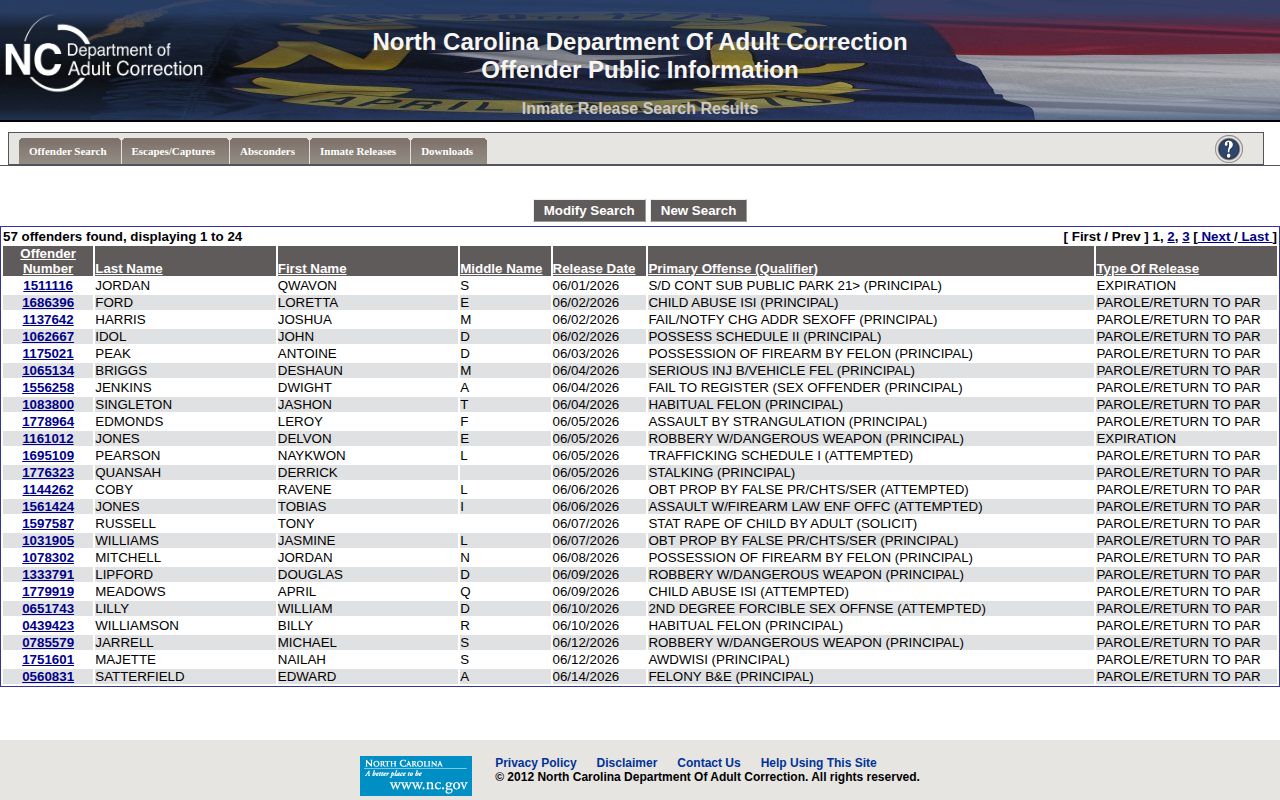
The list is useful for a recent state release, while the full offender record supplies the projected date and status context. Older state history may remain in OPI after a year is no longer offered by the release-list selector.
North Carolina State Release Calculation
North Carolina Structured Sentencing applies to crimes committed on or after October 1, 1994. The official parole explanation says it eliminated traditional parole for those cases. It also describes service of at least the full minimum and approximately 85 percent of the maximum. The percentage is shorthand, not a rule that every person serves exactly the same fraction.
G.S. 15A-1340.13(d) provides the precise floor. An active felon must serve the minimum term imposed. Earned time may reduce the maximum, but never below that minimum. The sentencing grid and maximum-term formulas, including the post-release component, appear in G.S. 15A-1340.17.
For post-release supervision, G.S. 15A-1368.2 sets release at the maximum less twelve months for Class B1 through E felonies, less nine months for Class F through I felonies, or less sixty months for specified registrable B1 through E sex offenses, with the earned-time adjustment allowed by law. Completion of that supervision terminates the sentence. These formulas explain why prison exit and final sentence discharge are not the same date.
Legacy parole cases follow different rules. The judgment date, offense date, sentence class, credits, and governing sentencing law must be known before anyone tries to explain eligibility or a release date.
Guilford Jail Credit Rules
Guilford County misdemeanor time does not use the state-felony percentage as a shortcut. The local credit framework differs sharply from the common state-felony shorthand. G.S. 148-13 authorizes NCDAC earned-time rules and requires local jails to apply distributed earned and good-time regulations for sentenced jail prisoners.
Under G.S. 15A-1340.20, a person serving a local misdemeanor sentence serves each day except for lawful credits, and combined earned credit is capped at four days per month. G.S. 162-60 describes four days per thirty days for qualifying work and up to four days per thirty days for qualifying education, rehabilitation, or training, subject to the custodian’s determination. Escape or attempted escape forfeits credit.
Do not add both figures and announce an automatic eight-day reduction. The misdemeanor statute caps the combined earned credit. A reliable Guilford calculation starts with the judgment, adds jail credit already awarded, applies only credits the custodian authorized, accounts for concurrent or consecutive sentences, and checks other holds. The jail record is the source for the resulting local date.
Note: No official Guilford release-door schedule or weekend pickup rule was found, so a calculated date is not a promised exit time.
Why Guilford Release Dates Change
A projected date can move when the sentence record changes or new custody facts appear. Some changes correct the calculation. Others reflect conduct, another judgment, or a legal hold. The table names the factor without predicting its effect in a specific Guilford County case.
| Factor | Possible effect | Best confirmation |
|---|---|---|
| Sentence audit or correction | Corrected dates, term structure, or statutory calculation can move the projection. | NCDAC sentence record or amended judgment. |
| Jail credit | Verified presentence custody credit can change time remaining. | Judgment and custodian calculation. |
| Earned credit award or forfeiture | Authorized credit may reduce time within the statutory floor; loss can extend the projection. | NCDAC or jail record. |
| Concurrent or consecutive terms | The way multiple judgments run changes the total calculation. | Complete set of judgments and sentence blocks. |
| Amended order or revocation | A later court or Commission action can alter custody and service dates. | Court docket, judgment, or Commission record. |
| Additional sentence or detainer | Release from one term may become transfer to another custodian rather than community release. | Holding agency and receiving agency records. |
| Post-release formula | Prison exit may occur before sentence termination because supervision follows. | NCDAC release and supervision fields. |
A detainer is a request or notice that another authority may assume custody. It does not erase the release from the first agency, but it changes what that event means. Always state “released from NCDAC” or “released from GCSO,” then add a supported transfer or supervision note.
Guilford Pretrial Release Has No PRD
A Guilford pretrial detainee does not have an NCDAC Projected Release Date merely because the person is in jail. The court may set or change bond, release the person on recognizance, order monitoring through Guilford Court Services, dismiss a charge, or issue another order. A second case or outside hold can prevent physical release after one condition is met.
Guilford Court Services interviews people for first appearance, verifies information, develops release recommendations, and may monitor a judge-ordered supervised release. First appearances occur each business day for those arrested since the preceding first appearance who have not made bond. Court Services involvement describes a local pretrial route. It is not NCDAC probation, parole, or a final case disposition.
Check the court order for legal authority, then contact Greensboro Detention Center at 336-641-2700 or High Point Detention Center at 336-641-7900 for physical custody and movement. If exact proof matters, request the booking or release sheet, actual release time if maintained, and coded disposition through the GCSO Records Section.
Confirm Guilford Actual Release
For a state prisoner, the NCDAC Actual Release Date and paired status fields are stronger than the projected field. For a local jail sentence, use the GCSO release or custody-movement record. A court judgment explains the legal basis but may not show when jail staff finished processing. A source-labeled VINELink event can provide timely corroboration.
Register before an expected change if notice matters. The Guilford County VINELink check explains how to select the exact North Carolina record and preserve the agency label. A Guilford jail alert and an NCDAC alert remain separate custody events even inside the same service.
Never promise a pickup time from a projected date. Use the date to plan a follow-up, then check the actual record and current custodian. The safest statement names the field, displayed date, and NCDAC as the source. After processing, replace that estimate with the supported Actual Release Date and note any active supervision or transfer.
When the public state record does not answer the question, NCDAC accepts an online public-record request. Supply the offender number, exact record type, and date range. Ask for the public sentence and release fields, such as admission date, sentence length, time served, actual release date, and the sentence record that supports the calculation. NCDAC states that simple requests can take days, while complex or redaction-heavy requests may take weeks or months. Electronic copies are its default. This state route is not for a Guilford jail-only stay.
Federal dates need their own label. A future date in the BOP locator is projected and may change. A past Release Date with no facility, along with RELEASED or Not in BOP Custody status, confirms only that BOP custody ended. “IN TRANSIT” is movement, not release. A federal defendant once housed at Greensboro Detention Center may remain under USMS control even after leaving the county roster, so the federal court order and receiving system can matter more than a local disappearance.