
Guilford Parole and Probation Compared
Probation usually lets a person serve a court-ordered term in the community instead of serving an active prison term, or follows a suspended sentence. Parole is conditional release from prison under the law that applies to an older or otherwise eligible sentence. North Carolina Structured Sentencing generally replaced traditional parole for felony offenses committed on or after October 1, 1994. Those cases commonly use post-release supervision, a statutory phase that follows prison and remains part of the sentence.
These labels matter in Guilford County. A person can be out of prison yet have an active “Probation/Parole/Post Release Status” in the NCDAC Offender Public Information Search. By contrast, Guilford Court Services may monitor a judge-ordered supervised pretrial release while a case is pending. That local program is not NCDAC probation, parole, or post-release supervision.
| Status | How it begins | Best public check |
|---|---|---|
| Probation | A criminal judgment places the person under community supervision, often with an active term suspended. | NCDAC active probationer/parolee status plus the court judgment. |
| Parole | An eligible legacy sentence permits conditional prison release. | NCDAC record, parole dates, and Commission contact. |
| Post-release supervision | State law places a structured-sentencing prisoner under conditions after prison release. | NCDAC Actual Release Date and active post-release status. |
| Supervised pretrial release | A Guilford judge orders release and county Court Services monitoring before disposition. | Guilford court record and Court Services, not the state parole search. |
- Discharge
- The formal end of the relevant supervision or sentence relationship.
- Absconder
- A person whom the supervising agency reports as avoiding required contact.
- Recognizance
- Release based on a promise to appear, without treating the case as resolved.
- Revocation
- A legal action that ends community supervision and may return a person to custody.
Check Guilford Post-Release Supervision
The NCDAC public search is the main case-specific route for state supervision. It includes current state prisoners, probationers, parolees, and historical state records, but it excludes county-jail-only custody. Use an offender number when known. A name search should be checked against Guilford as the conviction county, docket data, birth information when displayed, offense date, and sentence dates.
- Open the official NCDAC offender search and choose “Active Probationer/Parolee.” Use “All” if the current category is uncertain.
- Enter the offender number or enough identity fields to narrow the result. Do not select a record on name alone.
- Open the matching record. Read “Inmate Status” and “Probation/Parole/Post Release Status” together.
- Check Actual Release Date, parole begin or end dates, sentence blocks, and the named Probation/Parole Office.
- Contact that office or NCDAC when a current status needs confirmation. Public OPI data does not expose case notes or every condition.
- Use the court judgment to distinguish probation from a prison sentence followed by post-release supervision.
The state form itself shows why the status choice matters. The official NCDAC search fields include Active Inmate, Active Probationer/Parolee, Inactive, and All.
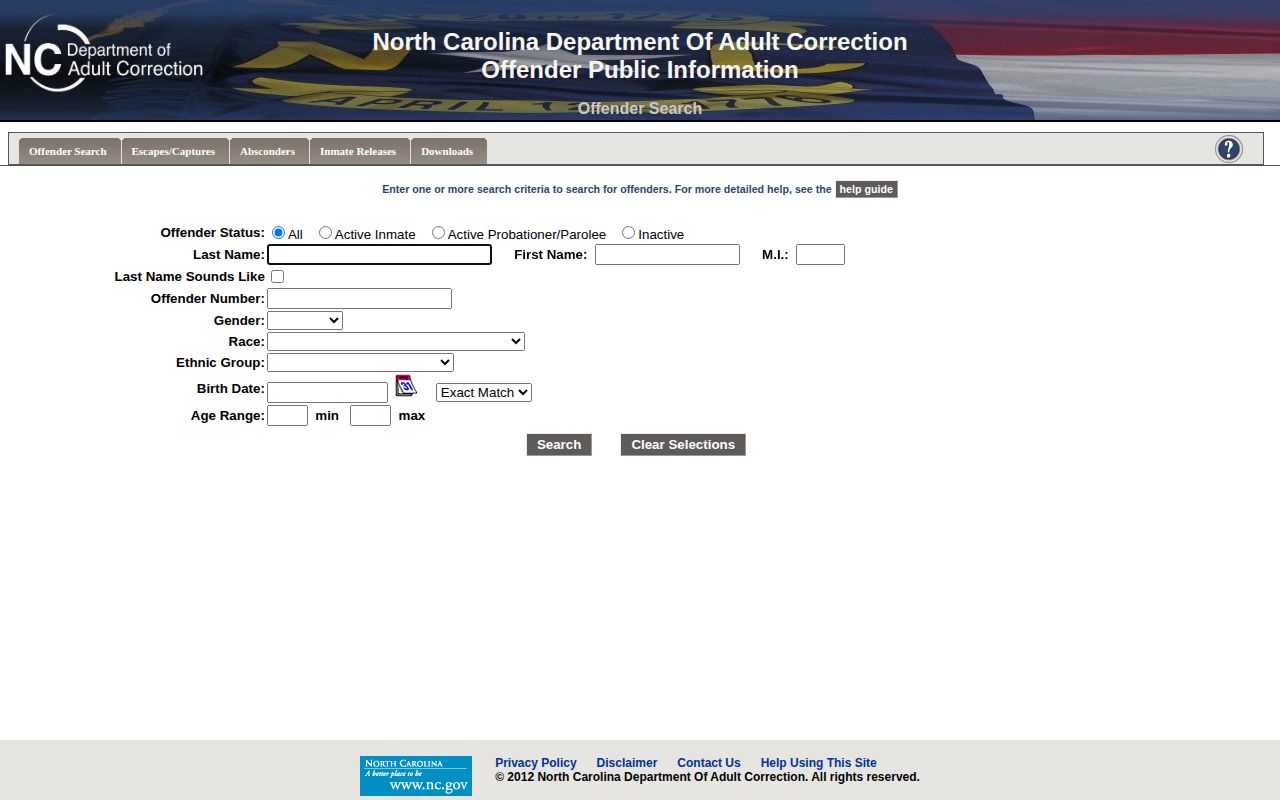
An inactive prison status can appear beside active supervision. That pairing means state confinement ended, not necessarily that every duty or sentence term ended.
Note: NCDAC records do not cover a Guilford jail stay that produced no state sentence or state community supervision.
Guilford Supervision Office Records
The individual NCDAC result names the Probation/Parole Office associated with the record. That field is more useful than guessing which building serves an address. Office assignments can change, and the research did not establish one fixed local office for every Guilford County case. Ask NCDAC to confirm the current office when the public record is unclear.
North Carolina Post-Release Supervision and Parole Commission2020 Yonkers Road
4222 Mail Service Center
Raleigh, NC 27699-4222
Phone: 919-716-3010
Fax: 919-716-3987
Email: Parole.Commission@dac.nc.gov
The Commission’s official page explains state process and policy. It does not replace OPI as the practical public source for a named person’s current status. If the record concerns probation rather than parole review, start with the office shown on the OPI result and the sentencing court file.
Guilford Parole Uses File Review
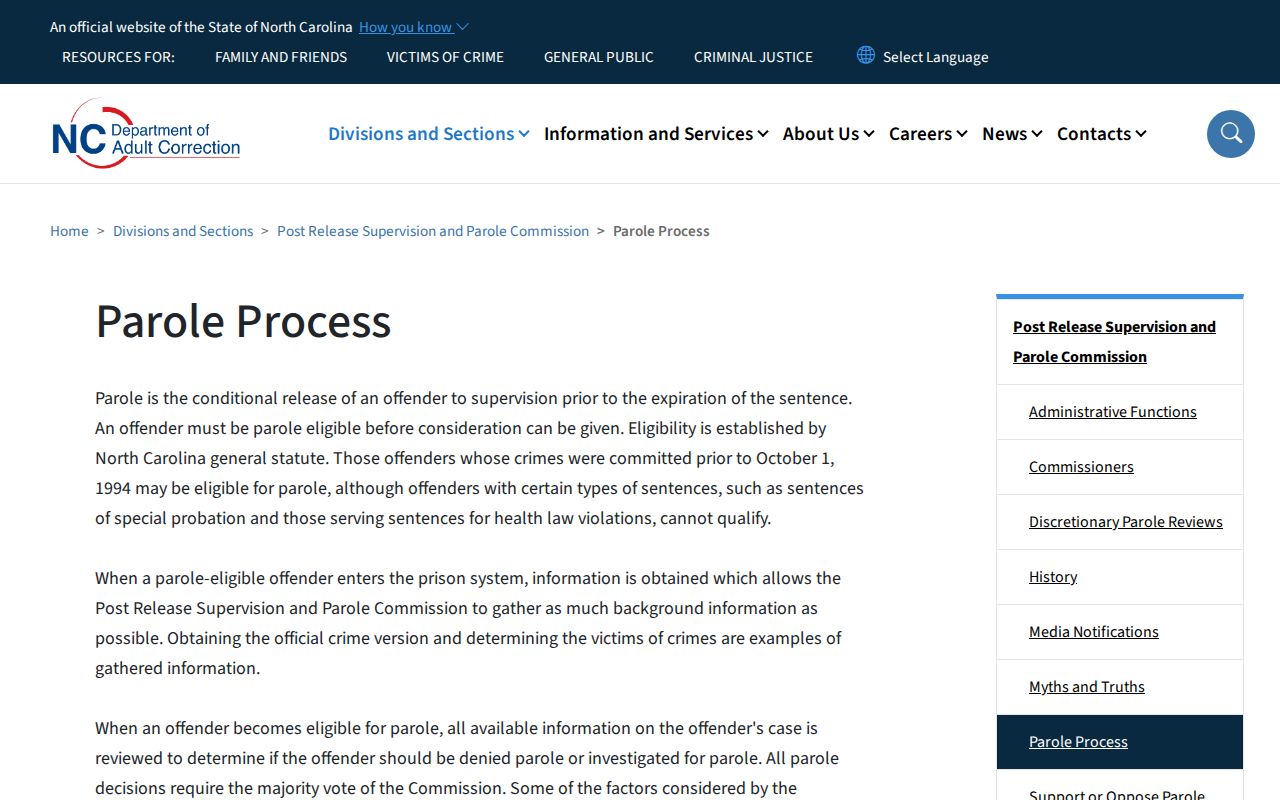
North Carolina does not run a conventional public calendar of formal parole hearings. The Commission says it ordinarily does not hold formal hearings or meet personally with the person under review. Commissioners independently review the file and vote. A majority controls the outcome. This is why there is no public Guilford County hearing date to look up and no complete public decisions database to search.
For eligible cases, the official process describes review at least once a year in ordinary cases, every three years in murder cases, and every two years for sexually violent offenses. A narrow exception permits certain people convicted as juveniles and serving life with parole to appear by video for a short review. Denial reasons are confidential. Registered interested persons may receive notice of a denial and the next review, and approval begins an investigation and notice process.
The Commission parole process documents the absence of a traditional calendar.
For a public result, check OPI parole begin and end dates, the present supervision line, Commission contact, and NC SAVAN notifications. Never calculate eligibility without the judgment, offense date, sentence law, and full record.
Guilford Absconders and Warrants
The NCDAC absconder search is the official public state tool for a person reported to be avoiding supervision. An entry means the supervision agency lists the person as an absconder. It does not prove a new arrest, show a present jail, or supply a new release date. Confirm the identity through the offender number and the linked supervision record.
Guilford warrants are a separate issue. The GCSO services page lists the Greensboro Warrant Office at 201 S. Edgeworth Street and 336-641-2727 on weekdays from 8 a.m. to 5 p.m.; Staff Duty handles nights and weekends at 336-641-3355. The High Point Warrant Office is at 507 E. Green Drive, 336-641-7907, on the same weekday hours. A warrant inquiry cannot substitute for the state supervision check.
When supervision moved to another state, the Interstate Compact public search may provide the proper lead. Match the source, since interstate transfer does not by itself end North Carolina supervision.
Note: An absconder result describes agency status; only a current custodian can confirm whether the person has since been arrested.
Guilford Supervision Terms and Violations
Conditions depend on the judgment, supervision type, and Commission or court order. Public records can establish the broad status, office, service dates, and some sentence data. They do not provide every instruction, meeting note, or alleged violation. A violation may lead to added controls, a court or Commission response, revocation, or custody, but an alleged violation is not the same as a final finding.
NC SAVAN and VINELink can add source-based alerts. The service receives both county-jail and state-prison data, so the agency label must be read. A Guilford jail custody event differs from an NCDAC prison or supervision event, even if both concern the same person. Register on the exact record and keep the four-digit PIN used to confirm or change alerts. For a durable account of release and supervision, pair the alert with the NCDAC record and judgment.
Guilford Re-entry After Release
The Sheriff’s Guilford County Re-entry Program is a local support route, not a status database. The county says anyone released from either Greensboro Detention Center or High Point Detention Center may be eligible. A Guilford resident may seek help no matter how long ago release occurred, though available services can vary.
A person still in either jail can message “re-entry” through a kiosk inside the jail. After release, the program lists help tied to food, behavioral health and substance-use treatment, family support, child care, education, and referrals. The program is free. Its office is at 505 E. Green Drive, Room 132, High Point; contact GCRC@guilfordcountync.gov or 336-641-2108.
Participation does not prove parole, probation, discharge, or a past release date. Use the state and court records for those facts. The program answers a different need: linking a Guilford County resident with practical support after leaving custody. Program eligibility also does not mean that NCDAC assigned, approved, or closed a supervision case. Keep the service referral and legal status in separate records.
When Guilford Supervision Ends
Supervision ends through the legal process that controls the case. A probation term may expire or be terminated by court action. Eligible parole reaches its end under the applicable order and law. Completion of post-release supervision terminates the structured sentence. The public NCDAC record should then no longer show active probation, parole, or post-release status, though processing time and historical sentence blocks may remain.
Confirm the end date in OPI and compare it with the court judgment or Commission record. “Inactive” should be read in context, not as a claim about all other cases or jurisdictions. For the custody event that came before supervision, the Guilford County released inmate search and records path explains how to obtain the local release sheet and distinguish community release from transfer.
Exact wording is useful: “NCDAC lists the person as inactive with no active post-release status” is stronger than a broad claim that all legal obligations ended. It names the source and the scope of the finding.