
Guilford County 72-Hour Release Gap
No official Guilford County Sheriff's Office view lists releases over a rolling 72-hour period. Research also found no verified 48-hour release page, generic released-person view, downloadable log, or public archive in the Sheriff's navigation. GCSO links to current Inmate Search and Recent Arrests. Those tools have different functions. One reflects the current custody catalog; the other records recent arrests. Neither identifies all people who left either Guilford jail during three days.
A wider period increases the number of possible movements that need review. Guilford can transfer people between Greensboro and High Point at any time. A person may also move into NCDAC custody after sentencing, another county's custody, federal custody, or immigration custody. Since GCSO publishes no roster cadence or release-feed retention policy, scraping names at intervals would produce an unverified difference list, not a Guilford County release record.
Review Guilford County Three-Day Releases
Build the review around supported events. Note the start and end of the 72-hour period and keep the time of each portal check. Then seek an affirmative movement code, actual release time, or source-agency event. This is slower than reading a feed, but it preserves the difference between a true discharge and a transfer. When asking about a broad period, request an existing release log only if GCSO maintains one. The agency is not required to compile a new list from separate files.
- Define the exact three-day period, including dates and local times, rather than saying “the weekend” without boundaries.
- Check the P2C current catalog and save the date and time. Use Recent Arrests only to identify the likely booking episode.
- Call Greensboro Detention Center at 336-641-2700 or High Point Detention Center at 336-641-7900 for the movement disposition.
- Compare a source-labeled VINELink event and the statewide court record. Each answers a different part of the release question.
- Search NCDAC when state commitment is possible, and check the receiving federal or immigration system when facts point there.
- Ask the GCSO Records Section for an existing release sheet or custody-movement record when documentary proof is needed.
A same-day question is narrower. The Guilford County 24-Hour Release List page focuses on today's checks and immediate pickup logistics rather than a multi-day reconciliation.
Keep the review chronological. For each day, log the portal check, any jail contact, the source agency on a VINELink event, and the date of a court action. Do not fill gaps with a presumed release. A later NCDAC match can explain why a person left the county view, while a jail movement record can show a shift between Guilford facilities. When dates conflict, treat the responsible custodian's record as the source for its own event and ask that office to correct or explain its data.
Guilford County Three-Day Record Fields
No public three-day feed means there are no verified portal columns to reproduce. Instead, ask for the existing fields that identify the person, the custody episode, and what ended it. Exact field names can vary within agency records. A field set is most useful when the booking number, facility, time, and disposition all describe the same episode.
| Field | Role in a 72-hour review |
|---|---|
| Name and agency identifier | Helps avoid joining two people with similar names. |
| Booking date and facility | Ties the event to Greensboro or High Point and the correct jail stay. |
| Actual release date and time | Places an affirmative agency event inside or outside the defined window. |
| Release disposition | May distinguish bond, recognizance, time served, completion, or another reason. |
| Custody movement | Can show an inter-facility move or transfer to another authority. |
| Case number | Connects the custody event to a court order or disposition. |
“Released” should always name the agency. A GCSO release may mean release from county custody, not from NCDAC, USMS, BOP, or ICE. Likewise, an NCDAC row reported to Guilford is a state-prison release destination record, not a list of people discharged from a Guilford jail.
The release type also affects the next source. A bond or recognizance release leaves a case pending, so the court docket should be checked for future action. Time served or sentence completion may close one custody term while a separate hold remains. A transfer calls for the receiving authority's locator or record. If post-release supervision follows state prison, NCDAC can show prison exit and an active supervision line at the same time. The three-day review is complete only when the disposition and next custodian, if any, are kept distinct.
Note: The county has not published a retention period for a released-person view because no such public view was found.
Guilford County Weekend Release Checks
A 72-hour review is useful when the period crosses a weekend or holiday because it creates room for repeated checks and office follow-up. It does not prove that processing follows a fixed weekend schedule. GCSO publishes no public release hours, holiday cadence, family waiting rule, or guaranteed time between a court order and a jail discharge. A court can authorize release before the detention center completes identification, records, property, and other required processing.
Record what each source showed at each time. If a court event falls on one date and the person disappears from P2C later, the gap still does not supply the actual jail release time. Call the detention center for status, then request the release sheet when the time and reason matter. If staff cannot confirm details by phone, contact the Records Section after business hours end. The statewide court Portal can preserve the legal event, while the jail record supplies the physical custody event.
Holiday timing deserves the same restraint. County government posts general weekday office hours, but jail operations continue and no public release-processing timetable was found. Records staff availability and custody processing are not the same schedule. A Monday response may document an event that happened earlier, yet the response date is not the release date. Define the window first and use the actual event field when the agency provides it.
Guilford County Portal Release Clues
The official GCSO Inmate Search is useful at the start and end of a three-day period only as a current-custody clue. The image below shows the correct official interface, not a 72-hour release archive.
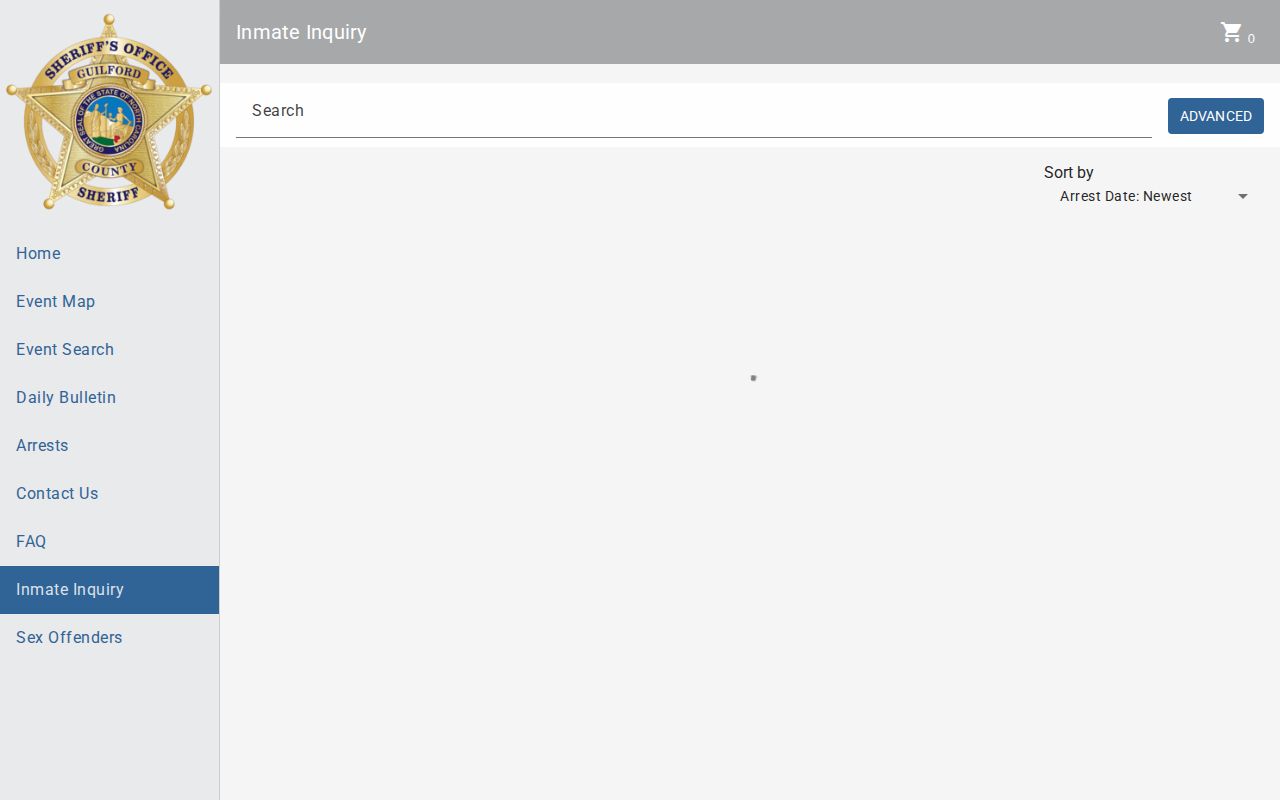
A person missing from the screen may have been discharged, shifted to High Point or Greensboro, committed to state prison, transferred elsewhere, or affected by a feed delay. The portal alone cannot select among those outcomes.
The GCSO Recent Arrests portal can help locate the correct booking context during that period.
It must not be relabeled as a release source. An arrest record does not show that custody ended, that the case ended, or that a person was convicted.
Guilford County Release Movement Quirk
Guilford's two-jail structure makes roster-difference methods especially weak. Greensboro Detention Center is the principal adult jail, while High Point Detention Center follows the same GCSO policies. The county expressly says people can be assigned or transferred between the two at any time. A move from one building to the other remains Guilford County custody. It is not a release at all.
Greensboro also holds a smaller federal and transfer-awaiting population. A county display can end while USMS remains the legal custodian. In a three-day review, ask which authority received the person, then use that authority's system. NCDAC's offender search applies to state custody and supervision, BOP applies to its federal records, and ICE ODLS applies to current and recent ICE custody. The source label is part of the finding.
Request Guilford County Release Proof
The GCSO Legal Process Division includes the Records Section. Its Greensboro office is at 201 S. Eugene St., Room 103LE, and its phone is 336-641-3735. The High Point Records contact is 336-641-7907. No specialized release-record form, guaranteed turnaround, or release-feed fee is published. Ask for an existing record with a narrow date range, person identifiers, facility, booking number, and case number.
Guilford County's general public-record process says routine requests are generally provided within 30 business days, while matters requiring coordination or review can take longer. That general goal does not turn a three-day release inquiry into an instant report. Ordinary county copy rates also do not prove a specific sheriff release sheet will carry a set fee. Ask for an estimate before paid work and request electronic delivery when practical.
A focused request seeks the booking sheet, custody-movement or release sheet, actual release date and time, and coded disposition. Ask the agency to identify the statutory basis for any withheld item and to provide nonexempt portions. North Carolina law permits access to public records subject to legal limits, but an office need not create a three-day compilation it does not maintain. The named person's Guilford County release search offers the fuller agency-by-agency route when the goal is one person's status rather than all events in a window.
- Roster absence
- A lead that requires confirmation.
- Movement record
- An agency record showing where custody went next.
- Release disposition
- The coded reason that one custody episode ended.
- Court event
- The legal action that may explain release, but not the processing time.