
Guilford County Release Meanings
“Released” describes the end of custody by one named agency. It does not always mean the person went home. Someone may leave the Greensboro Detention Center after posting bond, receiving a judge’s release order, finishing a local sentence, or having a charge dismissed. The same person may instead move to High Point, another county jail, the North Carolina Department of Adult Correction, the U.S. Marshals Service, or immigration custody. Each movement ends one custody entry, yet only some return the person to the community.
That distinction controls the search. Guilford County Sheriff’s Office records are the best source for the jail’s actual movement date and disposition. NCDAC records apply when a sentence or supervision entered the state system. A court docket explains orders, judgments, and case outcomes but does not provide the hour when jail staff completed discharge. VINELink supplies a source-labeled custody event and alerts. A careful result states who released the person, on what supported date, and whether transfer or supervision remained.
Key definition: discharge ends a stated custody or supervision component; time served means the credited term was met; a detainer asks one custodian to hold or notify another authority.
Guilford County Release Types
Local jail records use a release disposition or movement code to describe what happened. The court file may supply the legal reason. Read both when the difference matters. Bond and recognizance releases are conditional exits before the case is resolved. Probation is a court-ordered community sentence, while parole applies mainly to eligible older North Carolina sentences. Post-release supervision follows many modern state prison terms. None of those words means a charge was dismissed.
| Release or movement | What it means | Next place to check |
|---|---|---|
| Bond or recognizance | The person leaves jail under court conditions while the case continues. | GCSO release sheet and eCourts Portal |
| Dismissal or court order | A judicial event may end the basis for that hold. | Court case and jail processing record |
| Time served or completion | The credited local term has ended. | Judgment, jail credits, and release sheet |
| State commitment | County custody ends through transfer to NCDAC. | NCDAC Offender Public Information Search |
| Federal or immigration transfer | GCSO custody can end while another authority takes control. | BOP, federal court, USMS, or ICE source |
| Parole or post-release supervision | Prison custody ends, but state supervision continues. | NCDAC status fields and supervising office |
Guilford County Release Record Fields
A county release record ties the exit to the original booking. GCSO does not publish a stand-alone online release certificate or a complete recent-release archive. Request the existing booking or custody movement record and describe the wanted fields. An agency need not create a new report that it does not keep. Exact public content can vary with the record, redactions, juvenile confidentiality, and court restrictions.
| Field | What it shows |
|---|---|
| Booking or inmate identifier | Connects the release to the correct custody episode. |
| Name and identity details | Helps separate people with similar names. |
| Booking date and facility | Shows when and where GCSO custody began. |
| Release or movement date | Records when the named custodian ended or changed custody. |
| Release disposition | May identify bond, court order, completion, or transfer. |
| Charge, case, and bond references | Points to the court file that explains the legal posture. |
| Receiving authority | Distinguishes community discharge from a transfer when maintained. |
For a state case, the public offender record is richer. It can show Inmate Status, Probation/Parole/Post Release Status, conviction county, sentence dates, Actual Release Date, Projected Release Date, parole dates, offense information, and the supervising office. Read both status lines. “Inactive” inmate status can appear with active supervision, meaning prison custody ended but state control did not.
Request Guilford County Release Records
GCSO’s Records Section is the durable route when the current roster no longer answers the question. The county’s online public-record portal is not the recommended channel for Sheriff’s Office records. Send a narrow request to the Sheriff’s Legal Process and Records Section. Greensboro Records can be reached at 336-641-3735 and High Point at 336-641-7907. Identify the person, facility, booking date range, case or booking number, and the exact release fields needed.
- Confirm whether Greensboro or High Point last held the person.
- Record the full name and any public booking, offender, or case number.
- Ask for the existing booking sheet, custody movement, actual release date, disposition, and receiving authority if maintained.
- Request the record in the format the office already keeps and ask for a cost estimate before any special service work.
- Compare the response with the court judgment or NCDAC record when another system was involved.
North Carolina law permits fees tied to the actual cost of copies and a special service charge for unusually extensive use of resources. The research found no published GCSO fee, fixed turnaround, or release-record retention schedule. Do not promise a free copy or a set response day. If a record is withheld or redacted, ask which law supports that decision.
Guilford County Release Record Law
North Carolina General Statute 132-1 defines public records broadly, and G.S. 132-6 provides access and copies as promptly as possible. Criminal investigation records receive different treatment under G.S. 132-1.4, although listed arrest facts are public. Clerk records are generally open under G.S. 7A-109. These rules do not make confidential juvenile records public and do not override a seal or expunction order.
Expunction is a court process that removes eligible official criminal records under the governing statute and order. It is not the same as release. An old booking can remain tied to a case long after custody ended, while an expunged or sealed matter may disappear from normal public access. The current GCSO roster is not a historical archive. For older events, begin with the Clerk of Superior Court and request the narrow Sheriff record only after identifying the case and custody episode.
Count Guilford County Releases Correctly
GCSO reports about 19,000 bookings each year across the Greensboro and High Point detention centers. It also reports an average daily population above 800. Neither number is an annual release count. One person can have more than one booking, and daily population measures occupied custody rather than exits. Guilford County released inmate totals cannot be calculated by relabeling either figure.
| Published measure | What it measures | What it does not prove |
|---|---|---|
| About 19,000 yearly bookings | Admissions across two adult detention centers | Unique people or community releases |
| Average daily population above 800 | Average custody load | Release timing or annual discharge total |
| Current P2C listing | People displayed in current custody | Why an earlier name vanished |
Find Guilford County Released Inmates
Start with the system that last held the person. A current-custody check can show that the name remains in GCSO’s catalog, but absence is only a signal to investigate. Save the date, time, agency, and identifiers. Do not turn a before-and-after roster check into a release claim. An inter-facility move, state commitment, another county’s hold, federal transport, data delay, or name variation can produce the same visible change.
- Check the official GCSO P2C Inmate Search only for current display.
- Use Recent Arrests to identify the booking, never as a released-person list.
- Call the relevant jail and ask whether the movement was community discharge or transfer.
- Request the custody or release sheet for an affirmative date and disposition.
- Check eCourts Portal for the judgment, bond action, dismissal, or other legal event.
- Search NCDAC, VINELink, BOP, or ICE when the facts point to another custodian.
Why the name leaves the roster: the current catalog tracks present GCSO display, not a certified history of everyone released into the community.
The Guilford County 24-Hour Release List explains the same-day fallback because no official county release feed exists. When the key question is a calculated state date rather than a past event, use the Guilford County projected release date process.
Guilford County NCDAC Release Search
The NCDAC criminal offender search gateway covers state prisoners, probationers, parolees, and historical state records back to 1972. It expressly excludes county-jail-only information. Select Active Inmate for current prison custody, Active Probationer/Parolee for community supervision, Inactive for a completed or closed state record, or All when the distinction is unknown. Offender number is the strongest public search key.
| Search input | Best use |
|---|---|
| Offender number | Separates the matched state record from similar names. |
| Name and sounds-like option | Finds candidates when spelling is uncertain. |
| Birth date or age range | Checks identity without relying on name alone. |
| Gender, race, and ethnic group | Narrows broad result sets when appropriate. |
| Offender status | Separates custody, supervision, and inactive records. |
The separate NCDAC Inmate Release Search filters by release county, year, and month or by last name. Its result columns include offender number, name, Release Date, Primary Offense, and Type Of Release. “Release County: Guilford” means a state release reported to Guilford as a destination or reporting county. It does not mean the person was released from a Guilford jail.
The official release form shows the county, year, and month controls used for this distinct state list.
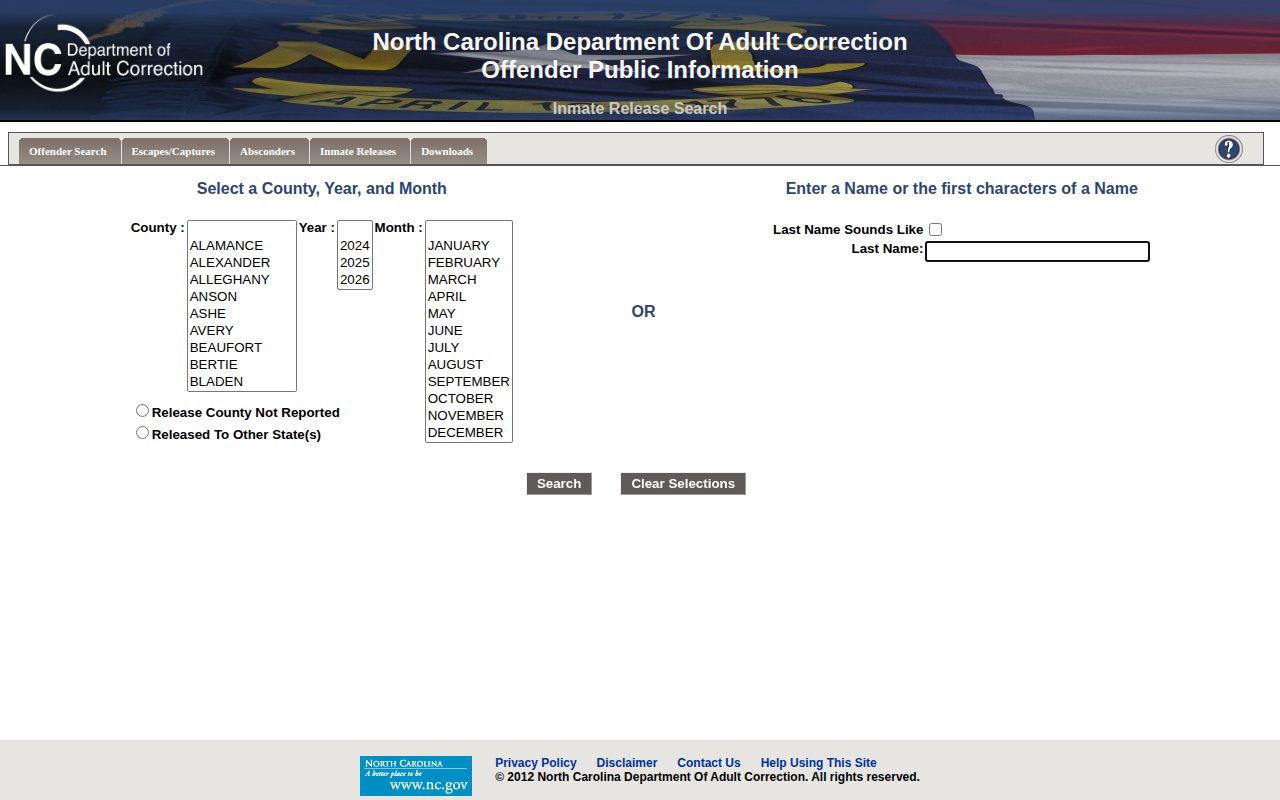
The screen belongs in a state-prison search path. A person who only spent time in Greensboro or High Point will not appear merely because the local jail released them.
Guilford County Release Court Records
Guilford cases use North Carolina’s eCourts Enterprise Justice, also called Odyssey, Portal. Smart Search can use a party name or case number and may offer location, birth date, case type, status, and date filters. The public Case Summary and Register of Actions can preserve a dismissal, judgment, probation order, hearing, bond action, or other event after a jail entry is gone.
A court event explains legal posture, not the real-time mechanics of a jail door. A signed release order can precede records checks, property return, transport, and discharge processing. A new hold can also prevent community release. Match the case number and party details, then pair the court result with GCSO’s actual release or movement record. A missing Portal result may reflect spelling, restricted access, migration, sealing, or expunction. It is not proof that no case existed.
Guilford County Supervised Release
Guilford Court Services creates a local path out of pretrial custody. Staff interview people scheduled for first appearance, verify information, develop release recommendations, and determine eligibility for monitoring. A judge may order recognizance, which is release on a promise to appear, or supervised custodial release with added monitoring. First appearances occur each business day for people arrested since the prior appearance who have not made bond.
This program is not NCDAC probation or parole. It can end jail custody before a final disposition while the criminal case remains open. Greensboro Court Services is at 201 S. Eugene Street, Room 360, 336-641-2660. High Point Court Services is at 505 E. Green Street, Suite 311, 336-641-2674. The shared email is courtservices@guilfordcountync.gov. Use the court order for legal conditions and the jail sheet for the completed release event.
Guilford County Post-Release Status
North Carolina’s public state supervision check is inside the NCDAC Offender Public Information Search. Choose Active Probationer/Parolee and open the matched record. Read Probation/Parole/Post Release Status and Probation/Parole Office. Read Inmate Status separately. Active supervision can remain even when prison status is inactive. An absconder is a person the supervising agency says has avoided required contact; an absconder result is not proof of a new arrest or current jail location.
For most felonies committed on or after October 1, 1994, Structured Sentencing replaced traditional discretionary parole with a prison minimum and maximum followed by statutory post-release supervision. Older and special sentence classes can still involve parole. The full verification and Commission process appears on the Guilford County parole and probation page.
Guilford County Release Cross-Checks
NC SAVAN uses VINELink for county-jail and NCDAC events. Search the exact North Carolina record, confirm the source agency, and read Custody Status. A Guilford jail alert and an NCDAC alert answer different questions even within one interface. Register before an expected change if a phone, text, or email notification is needed. VINELink is strong corroboration, but it is not a permanent certified release archive.
Greensboro holds a small federal population. A GCSO disappearance may therefore be movement under the U.S. Marshals Service. Search the federal court docket and the BOP Inmate Locator. A past Release Date with no facility or a RELEASED result means BOP custody ended, not that every supervision or hold ended. “IN TRANSIT” is not release. ICE’s locator covers current detainees and people reported released from ICE custody within the prior 60 days. A county discharge cannot be called a community release until the receiving authority is checked.
Help After Guilford County Release
The Sheriff’s Guilford County Re-entry Program is free for anyone released from either adult county detention center. A Guilford resident may ask for services no matter how long ago the release occurred, although available help can vary. A current detainee can begin by messaging “re-entry” through a kiosk inside the jail.
Program contacts can connect eligible people with food, behavioral health or substance-use treatment, family support, child care, education, and referrals. The program is not a custody lookup. Its office is at 505 E. Green Drive, Room 132, High Point. Contact GCRC@guilfordcountync.gov or 336-641-2108. Release status must still be confirmed through the jail, court, NCDAC, or other custodian.
Getting Home After Guilford Release
Greensboro Jail Central sits downtown near the Market and Edgeworth corridor. Current Greensboro Transit material identifies Routes 7 and/or 9 as nearby options. That is not a documented stop at a release door, and route schedules can change. Check the city’s current transit routes for the actual date and time.
GCSO publishes no set release exit, family waiting area, rideshare rule, or pickup policy. It also publishes no general release-processing schedule. Call the facility before making a trip, but do not treat an estimate as an official discharge time. No equally specific official High Point transit stop was verified in the research, so the same route claim should not be extended to that facility.
Mail After Guilford County Release
A former inmate may request digital copies of scanned nonlegal mail after leaving either adult detention center. The person must provide a full name, the correct facility, inmate ID rather than the commissary PIN, and an email address. After verification, the county sends a download link. Greensboro requests go to kclark0@guilfordcountync.gov. High Point requests go to ygeorge@guilfordcountync.gov.
This procedure is personal mail retrieval, not a way for someone else to verify a release. It does not supply the discharge disposition or prove that a person returned to the community. A third party seeking release facts should use Records. The former inmate should use the exact facility channel because the two adult centers have separate retrieval addresses.
Guilford County Custody Comparisons
No single search covers all Guilford County released inmates. Choose the system that owns the event and note what its result cannot establish.
| Source | Best answer | Main limit |
|---|---|---|
| GCSO P2C Inmate Search | Whether a person is currently displayed in county custody | Absence does not identify release or transfer |
| GCSO release record | Actual local movement date and disposition if maintained | Must usually be requested |
| NCDAC offender record | State custody, actual release date, and supervision status | Excludes local-jail-only custody |
| VINELink | Source-labeled custody event and notification | Not a permanent certified archive |
| eCourts Portal | Order, judgment, dismissal, and case posture | Not a physical locator or jail timestamp |
| BOP or ICE locator | Agency-specific federal or immigration custody status | Does not rule out other custody |
Guilford County Release Facilities
Greensboro Detention Center is the primary adult county jail and may hold pretrial, sentenced, federal, and transfer-awaiting detainees. High Point Detention Center follows the same GCSO policies, and people can move between the two at any time. A transfer between them is not a release from county custody.
The Guilford County Regional Juvenile Detention Center provides temporary secure care for youths awaiting court action or transfer. Juvenile custody and court information is confidential. Adult P2C, NCDAC release lists, and public adult record methods should not be used as substitutes for authorized juvenile channels.